


Kalarippayattu is far more than a fighting system — it is a complete discipline of combat, physical conditioning, meditation, and traditional medicine, developed and refined in Kerala over more than two thousand years. Often described as the "mother of martial arts," it is believed by many historians to be among the oldest continuously practiced martial art forms in the world. This guide covers its history, regional styles, training system, weapons, healing tradition, and its living influence on Kerala's culture and global cinema today.


The name comes from two Malayalam words: kalari, meaning "place of combat" or training ground, and payattu, meaning "practice" or "fight." While an exact date of origin cannot be fixed with certainty, historians place its roots somewhere between 200 BCE and 600 CE, with the art reaching its peak popularity between the 14th and 16th centuries, during a long period of conflict between South Indian dynasties.
Mythology credits two sages with founding the tradition. In the north, legend holds that Parashurama, regarded as the creator of Kerala itself, established 108 original kalaris and trained 21 gurus to carry the practice forward. In the south, the lineage is instead traced to the sage Agastya, who is also credited with identifying the 108 marma (vital) points of the human body that underpin the art's healing tradition.
For centuries, Kalarippayattu was closely associated with different warrior groups in various castes in the communities, and nearly every village maintained its own kalari to train the next generation in armed and unarmed combat, footwork, breathing, meditation, and healing. This combination of combat, discipline, and medicine is why the art is often called one of the earliest comprehensive martial systems in the world.
As Kalarippayattu evolved across different regions of Kerala, it diverged into distinct regional schools — each with its own emphasis, training environment, and even medical lineage.
Predominant in the Malabar region, this style emphasizes graceful body movement, agility, and weaponry, with training traditionally conducted in kalaris sunk below ground level. It traces its founding to the Parashurama legend and draws on Ayurvedic medicine for treatment.
Also called Adi Murai, this style flourished in the former Travancore region and leans towards raw power, efficiency, and free armed combat, often trained in open spaces or thatched structures at ground level. It traces its lineage to Sage Agastya and relies on Siddha medicine rather than Ayurveda.
A composite tradition from central Kerala, blending elements of both the Northern and Southern schools while retaining its own distinctive techniques and character.
A kalari is far more than a gymnasium — it is a sacred, purpose-built space. Traditionally oriented east-west with a low roof, the training floor is often sunk below ground level and made of packed earth mixed with medicinal herbs believed to aid in healing minor training injuries.

A seven-tiered altar in the south-western corner of the kalari, symbolizing the body's seven chakras. Practitioners offer flowers here to Goddess Bhadrakali, the patron deity of the kalari.
A second sacred spot between the Poothara and the western pillar, dedicated to the memory of the nameless, ancient masters who first shaped the art.
Students step into the kalari right foot first, bow to the guru, and offer dakshina before training begins — a ritual of respect carried through the Guru-Shishya Parampara, the oral, hands-on tradition through which the art has passed from teacher to student for generations, without any written manual.

Traditional Kalarippayattu training follows four progressive stages, sometimes with a fifth. Becoming a fully accomplished practitioner and eventual gurukkal (master teacher) typically takes at least 12 years of dedicated study under an experienced guru.
Exercises for the hands and legs — kicks, jumps, blocks, and turns inspired by the movements of birds and animals — building flexibility, mobility, focus, and dexterity.
Training with wooden weapons of increasing length and complexity: the Kettukari (long staff), Cheruvadi (short stick), and the curved Otta.
Attack and counter-attack training with metal weapons — sword and shield, daggers, spears, the flexible urumi, and double-edged blades (churika).
Facing an opponent unarmed — striking, grappling, and joint locks, grounded in a deep understanding of the body's vital points (marmam).
Many gurukkals consider the study of Kalari Marma treatment — healing through knowledge of the body's vital points — to be the fifth and final stage, reserved for the most dedicated students.
Weapons are introduced progressively, from wood to metal, only once a student has mastered the stage before it. Wooden weapons build precision and control; metal weapons demand complete mastery of distance, timing, and the body's vital points.

Marma Chikilsa evolved as a treatment system for injuries sustained during training and combat, rooted in the knowledge of 108 marma (vital) points on the human body — a science credited to Sage Agastya and closely tied to Siddha medicine. Mastering marma knowledge takes 10 to 12 years of dedicated study under a guru, and it is used to heal as precisely as it can be used to harm.
Central to this tradition is Uzhichil, therapeutic massage using traditional medicated oils, which gurus have long given students to build flexibility and treat training injuries. Kalari chikitsa recognizes three forms of massage:
Traditional oil massage
Massage performed by hand
Massage performed with the feet
Kalarippayattu's influence runs through much of Kerala's classical and ritual performing arts. Its body exercises shaped the physical training of Kathakali dance-theatre, lending it much of its strength, control, and precision of movement. Many Theyyam rituals draw on the physical stamina built through kalari training, and the imprint of its movement vocabulary can also be traced in Koodiyattam, Parichamuttukali, Velakkali, Kanniyarkali, and even Mohiniyattam. Together, Theyyam, Kathakali, and Kalarippayattu are often described as the cultural trinity of Kerala — a fusion of faith, art, and discipline.
Kalarippayattu's fortunes changed sharply under British colonial rule, when the martial art was suppressed for its association with regional resistance and warrior culture, pushing it toward the brink of extinction in many parts of Kerala.
Its 20th-century revival is credited in large part to Kottakkal Kanaran Gurukkal (1850–1941), sometimes called the "Dronacharya of Kalaripayattu," and his student C.V. Narayanan Nair. The pair brought the art out of the traditional, closed kalari and into public view, famously performing before Prime Minister Jawaharlal Nehru in 1954. Two years later, in 1956 — the same year Kerala was formed as a state — they founded the CVN Kalari Sangham, an institution that still trains practitioners today.
The Vadakkan Pattukal, or "Ballads of the North," are a body of Malayalam oral ballads from North Malabar, composed between the 12th and 20th centuries. They celebrate the Chekavar warriors — men and women trained in Kalarippayattu who were hired to fight ritual duels (ankam) to settle disputes between rival families and kingdoms. The ballads vividly describe kalari training and combat, and their heroes remain among the most recognizable figures in Kerala's folklore: Thacholi Othenan, Aromal Chekavar, Kannappa Chekavar, and the celebrated warrior-woman Unniyarcha, said to have won 64 kalari ankams in her youth.
The most celebrated cinematic telling of these ballads is Oru Vadakkan Veeragatha ("A Northern Tale of Valour"), directed by Hariharan and written by M.T. Vasudevan Nair. The film retells the legendary rivalry between cousins Aromal Chekavar and Chandu — but from Chandu's point of view.
In the traditional ballads, Chandu is remembered as a traitor who sabotaged Aromal's sword before a fatal duel out of jealousy. M.T. Vasudevan Nair's screenplay reimagines him instead as a man wronged by circumstance and prejudice — a tragic figure rather than a villain. Starring Mammootty as Chandu, the film won four National Film Awards in 1989 (Best Actor, Best Screenplay, Best Production Design, and Best Costume Design) and remains one of the most acclaimed portrayals of Kalarippayattu and its warrior culture on screen.
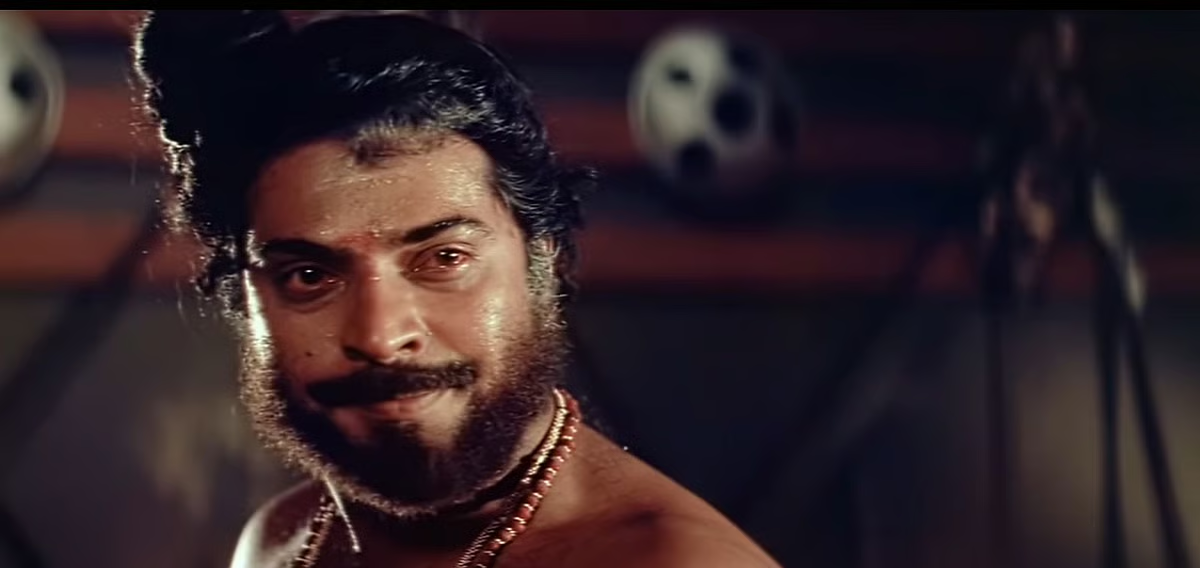
The Vadakkan Pattukal have inspired numerous other films built directly around the ballad heroes, including:
among others. Kaliyattam (1997), Jayaraj's Malayalam adaptation of Shakespeare's Othello, set its story against Kerala's Theyyam ritual tradition — closely tied to Kalarippayattu. More recently, Veeram (2016), Jayaraj's adaptation of Macbeth, cast Kunal Kapoor in a role for which he trained in Kalarippayattu.
Beyond period ballads, Kalarippayattu's techniques have shaped mainstream Indian and global action cinema. Bollywood star Vidyut Jammwal, who has trained in the art since childhood, brought it to films such as Commando, and is set to play Dhalsim in the 2026 Hollywood Street Fighter film — drawing on his real martial arts background for the role. Fellow action star Tiger Shroff trained in Kalarippayattu for his fight choreography in Baaghi. Meanwhile, practitioners like the late Unni Gurukkal (Sankaranarayana Menon), a Padma Shri recipient, carried the art abroad, establishing Vallabhatta Kalari branches across the UK, US, France, Belgium, and Sri Lanka.
Kalarippayattu is now officially recognized by the Ministry of Youth Affairs and Sports, Government of India, with the Indian Kalarippayattu Federation (IKF) serving as the national body for its promotion, working with affiliated state associations to standardize training and organize competitions. A landmark moment came in November 2023, when Kalarippayattu made its debut as a competitive discipline at the 37th National Games in Goa — the first time the art form appeared on India's biggest multi-sport stage.
"It is indeed the mother of all martial arts. There is no doubt about that. It has been a huge honour for all of us that we got a chance to showcase this unique sporting event at the National Games in Goa."
From village kalaris to national stadiums and international film sets, Kalarippayattu's journey reflects a living tradition — one that continues to train new generations while carrying forward centuries of discipline, philosophy, and healing knowledge.